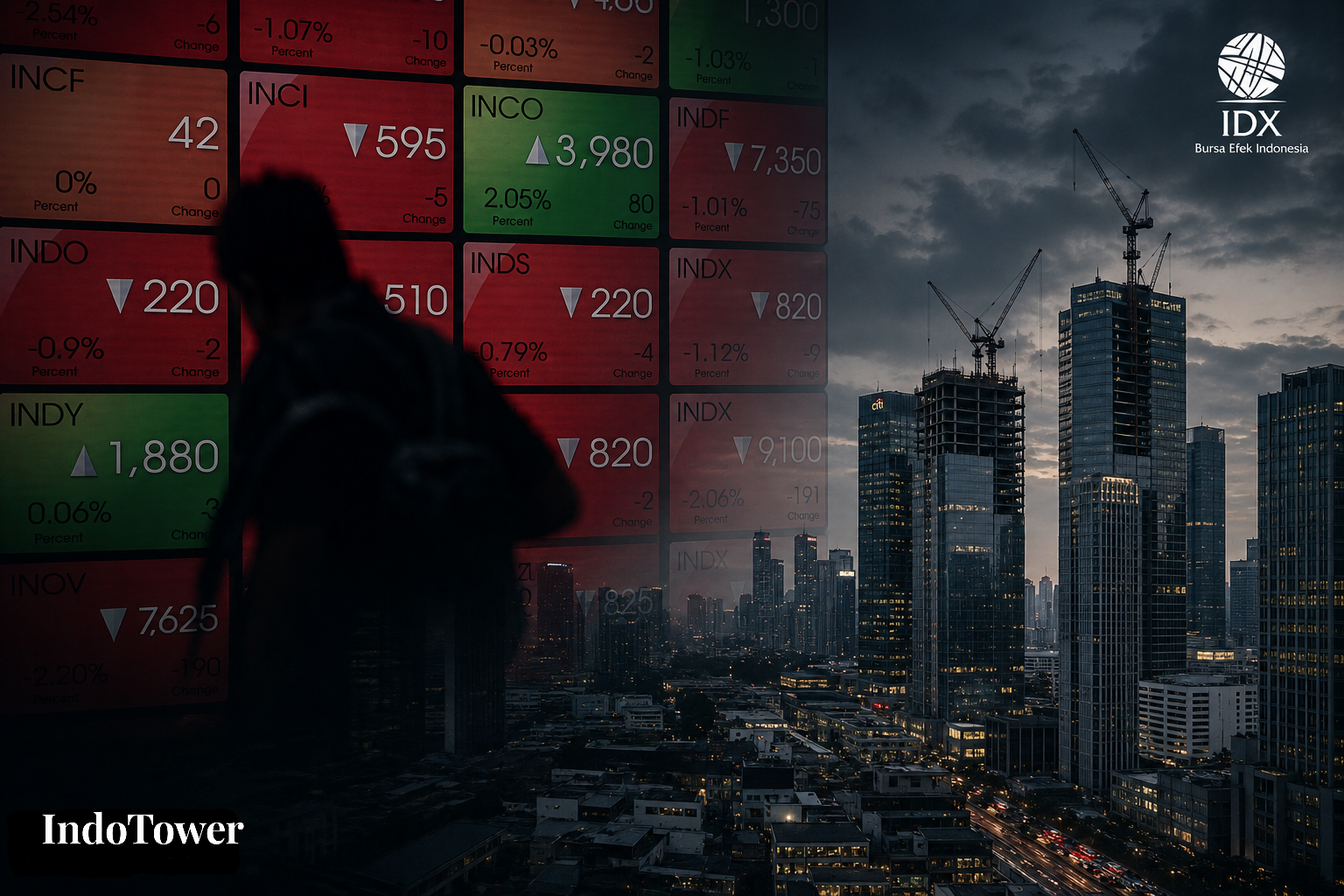
Indonesia's benchmark stock index opened 2026 near an all-time high. By the second week of June, it had collapsed more than 32% year-to-date — one of the steepest drawdowns in the history of the Jakarta Composite Index.
The fall has been swift and painful. IHSG touched its historical peak of 9,134.70 on January 20, 2026, before suffering a cascade of corrections concentrated between January and March. The single worst session came on January 28, when MSCI flagged concerns over share ownership transparency and free-float mechanisms on the Indonesian exchange, triggering a single-day collapse of 7.35%. By early June, the damage had compounded: on June 3, IHSG fell another 4.11% as investor confidence in the administration's policy direction deteriorated further. The index has since traded in the 5,700–5,900 range — levels last seen in early 2025.
Three pressures have converged simultaneously. First, a structural erosion of Indonesia's middle class has weakened the domestic consumption base that historically cushioned the economy from external shocks. Second, foreign capital has exited in scale — net foreign sell reached Rp 42.8 trillion from the start of 2026 through late May. Third, and perhaps most corrosive, is what analysts at Kiwoom Sekuritas describe as escalating "leadership and policy communication risk" — investor uncertainty not just about specific policies, but about the predictability of the policy environment itself.
Compounding these domestic factors is a global backdrop that offers little relief. Geopolitical tension in the Middle East has pushed investors toward safe-haven assets, strengthening the US dollar and pressuring emerging market currencies. Rupiah has borne much of this weight, touching an all-time low of Rp 17,922 per USD on June 3 — approaching the psychologically significant Rp 18,000 threshold. Two critical events remain ahead: MSCI's Global Market Accessibility Review around June 18 and its Annual Market Classification Review around June 23 — reviews that analysts describe as the next credibility test for Indonesia's capital market standing among global institutional investors.
The valuation picture, on paper, looks extreme. Samuel Sekuritas places IHSG's current P/E ratio at 14.6x — discounted 20% against MSCI Emerging Market peers and 30% below IHSG's own historical average. For context, during the peak of the COVID-19 pandemic in April 2020, IHSG's P/E bottomed at 12.9x. The market is approaching pandemic-floor territory. Yet analysts caution that cheap valuations alone are insufficient to attract foreign capital back when structural credibility concerns remain unresolved.
The Property Sector: Caught in the Crossfire
For the real estate sector, the IHSG collapse has created a paradox worth examining carefully.
The sector entered 2026 from a position of strength. The IDX Property Index gained 53.4% across 2025 — one of the strongest performances of any sectoral index — riding a confluence of positive catalysts: Bank Indonesia cut its benchmark rate five times during 2025, bringing it to 4.75%; the government extended its PPN DTP incentive at 100% through the end of 2027; and demand from the upper-middle segment remained resilient, largely insulated from KPR rate sensitivity because buyers in this segment predominantly transact in cash.
The market crash of 2026 has pulled property stocks down with the broader index. On June 3 alone, the IDX Property sector fell 4.85% — among the hardest-hit sectors that session. On June 4, it dropped another 4.99%. Major listed developers — PT Ciputra Development Tbk (CTRA), PT Bumi Serpong Damai Tbk (BSDE), PT Pakuwon Mitra Tbk (PWON), and PT Summarecon Agung Tbk (SMRA) — all registered sharp declines in tandem with the broader selloff.
But there is a meaningful difference between the market price of a property stock and the underlying business of building and selling real estate. Analysts from multiple institutions have consistently pointed to one data point: all four major property blue chips are currently trading at price-to-book values below 1x — meaning the market is pricing these companies at a discount to the value of assets they already own. Historically, PBV below 1x in the property sector has represented a significant margin of safety for long-term investors, particularly when the underlying demand environment remains intact.
BRI Danareksa Sekuritas analyst Abida Massi Armand characterizes the four differently: BSDE and SMRA as the most aggressive in marketing sales, CTRA as solid at scale, and PWON as defensively positioned through recurring income from its mall and hospitality portfolio. CTRA and PWON are seen as the most fundamentally resilient, given their significant recurring revenue base that provides earnings stability independent of new property launches.
The demand side has its own complexities. BI's decision to hold its benchmark rate at 4.75% in April 2026 was read as broadly neutral for the sector — KPR costs have not worsened, but they have not fallen enough to trigger mass-market demand acceleration. What remains structurally supportive is the PPN DTP extension through 2027, which analysts at Pilarmas Investindo note is most effective for the Rp 1–3 billion price segment — precisely where end-user demand is most concentrated.
The Physical Market: Construction Does Not Pause for Corrections
Perhaps the starkest divergence between financial markets and the real estate sector lies in the construction pipeline. While IHSG was losing a third of its value, Jakarta's vertical development activity showed no visible signs of deceleration.
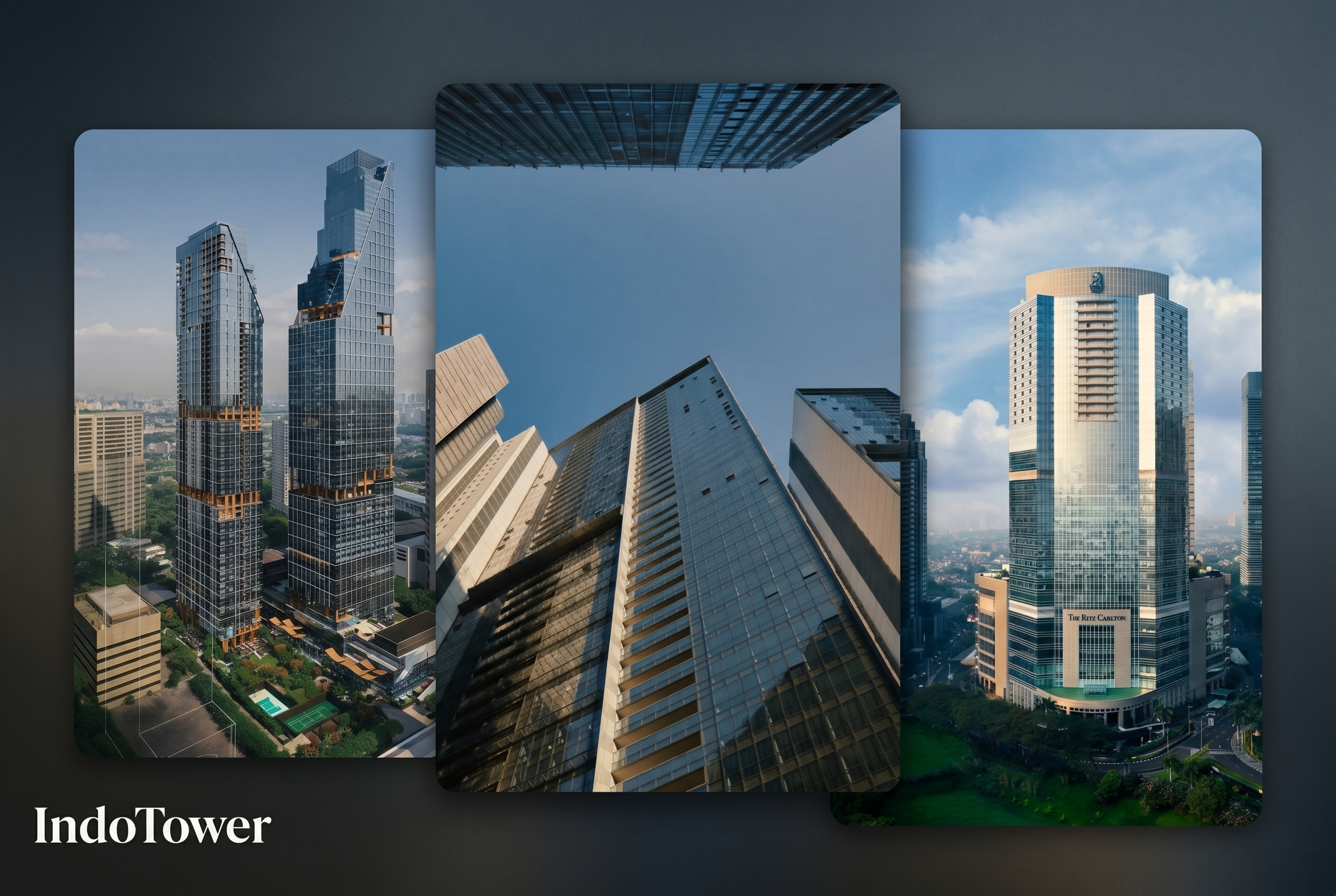
The Jakarta provincial government launched Jakarta Investment Festival 2026 with Rp 271.3 trillion in investment opportunities across 40 strategic projects and seven thematic zones — a signal that the city's development ambitions have not been scaled back despite the market environment. Two Sudirman Jakarta, the joint venture between Mitsubishi Estate, Taspen Properti, and PT Benhil Property, continues active construction with Tower A having cleared the seventh floor and Tower B at the fifth — indifferent to short-term market volatility by virtue of its 2028–2030 delivery horizon. Indonesia-1 Tower on Jalan Thamrin — the twin-tower complex acquired from distressed ownership by Indonesia's Media Group in 2022 — is approaching its topping-out phase and targeting a 2027 delivery.
This divergence is not incidental. It reflects a structural feature of large-scale property development: capital is committed at project inception, construction is contracted, and delivery timelines are set years in advance. A market correction in 2026 does not unwind a foundation poured in 2024. What it can affect is the financing environment for new project launches, access to capital markets for developers with leveraged balance sheets, and investment decisions for projects still in the planning stage.
Knight Frank Indonesia has noted that sustained IHSG declines reduce transaction activity across the property supply chain — affecting developers, agents, contractors, and material suppliers alike. In a prolonged bear market, the feedback loop from financial markets to physical markets becomes more pronounced over time.
What Comes Next
The near-term outlook for IHSG remains clouded. Samuel Sekuritas projects a bear case of 6,300 by year-end — implying only modest recovery from current levels — with a base case of 7,500 contingent on structural improvements in policy credibility and a reversal of foreign outflows. The key catalysts to watch are the MSCI reviews in late June 2026, which could either exacerbate the foreign-sell dynamic or provide a floor if Indonesia's market accessibility standing is preserved.
For property specifically, the consensus among analysts is cautious stability rather than recovery. The fundamental supports — PPN DTP extension, BI rate at 4.75%, strong institutional construction pipeline, and PBV valuations at multi-year lows — remain intact. The headwinds — weakened middle-class purchasing power, rupiah depreciation raising construction import costs, and subdued investor sentiment — are equally real.
The property sector has historically outperformed broader equity markets in the 12–18 months following major IHSG corrections, as real asset demand reasserts itself once macro uncertainty stabilizes. Whether 2026–2027 follows that pattern depends on variables that extend beyond the sector itself: primarily, whether the Indonesian government can restore investor confidence in the predictability and coherence of its economic policy framework.
Jakarta's cranes are still turning. The question is who will be positioned when the index eventually turns with them.